
Chapter 1
A Practical Approach to AI, Not Another Add-On
Chapter 2
Why AI Matters Now (and Why Most Companies Are Getting It Wrong)
Chapter 3
How Does Andrew Reise Use AI?
Chapter 4
AI-Powered Solutions Built for Security, Trust, and Enterprise Standards
Chapter 5
AI + Human Expertise, Not One or the Other
Chapter 6
Where We're Going Next
Chapter 7
Let's Talk About What AI Can Do for You

Chapter 1
A Practical Approach to AI, Not Another Add-On
Many firms position AI as a separate offering, something layered on top of existing strategy. In our opinion, this tends to produce fragmented efforts, unclear ownership, and limited ROI.
Andrew Reise embeds AI into the diagnostic and strategy process itself. Using AI/LLM-driven analytics, we analyze customer journeys, employee workflows, and digital behaviors to identify high-impact opportunities. We translate those findings into a clear, prioritized strategic roadmap that is broken into quick wins, foundational initiatives, and longer-term transformations, all of which are delivered through our CX as a Service model.
What is AI-Washing?
As AI adoption accelerates, so does a growing problem: AI-washing.
AI-washing refers to overstating or misrepresenting the use of artificial intelligence in products or services to appear more advanced. For enterprise leaders, this creates real risk:
- Investments are tied to unclear or inflated capabilities.
- Solutions don't integrate with existing operations.
- There is limited visibility into actual business impact.
Andrew Reise focuses on the places where AI creates measurable value. We’ve helped organizations realize hundreds of thousands in cost savings and uncovered significant revenue opportunities through more targeted experience improvements.
"Being able to run deep dive analyses in a very, very short amount of time — what could have taken months if not years — and doing it in real time has been an unlock for a lot of companies."
— Zach VanDolah, Consulting Director at Andrew Reise

%20(1).png?width=450&height=300&name=Create-Crazy-Loyal-Customers-450x300%20(3)%20(1).png)

Chapter 2
Why AI Matters Now (and Why Most Companies Are Getting It Wrong)
Leaders across industries are fielding the same question from boards, regulators, and customers alike:
“What are you doing with AI?”
If the answer is unclear, it creates a perception problem. Especially in regulated industries, standing still signals operational lag, not stability. Even if your stance toward AI involves less use than more, signaling your use, articulating a public position, and developing a plan going forward is the strongest way to support your growth and the stability of those you serve.
Where Do Most AI Efforts Break Down?
Most organizations are treating AI as a collection of tools to experiment with, rather than a capability to integrate. This results in a scattered effort with little measurable return, especially without the structure and coordination typically provided through strong project management.
Here's what we consistently see:
- Isolated pilots with no path to scale: Teams test agents, chatbots or analytics tools in silos but never connect them to core workflows.
- No clear link to business outcomes: AI initiatives aren't tied to cost reduction, efficiency gains, or customer experience improvements.
- Lack of integration across CX, EX, and DX: Customer data, employee workflows, and digital systems remain disconnected, limiting what AI can actually do.
- Security and governance gaps: AI is introduced without clear policies around data usage, compliance, or risk management.
- Vendor-driven agendas: Technology decisions are shaped by what vendors sell, not what the business actually needs.
The Fundamental Misconception: AI = Tools
Buying AI tools does not create transformation.
Real value comes from embedding AI into how work gets done, including how decisions are made, how processes flow, and how customer and employee experiences are designed.
The Reality: AI Is an Operational Strategy
Organizations that see results treat AI as part of their operating model, not a side initiative. That means using AI to identify friction across journeys and workflows, and embedding insights into a prioritized strategic roadmap.
This is where Andrew Reise focuses. We connect AI to the work that drives real performance.
For example, with Voice of Customer (VoC) initiatives, "AI gives us the tools to augment the VoC and have it as more of an infrastructure, it allows us to have that always-on listening." explains Katie Sexton, Consulting Director at Andrew Reise.



Chapter 3
How Does Andrew Reise Use AI?
AI is already built into the ways Andrew Reise delivers work.
Our primary focus is straightforward: reduce time to insight, improve decision quality, and scale high-value outputs, without adding cost or complexity for our clients.
Accelerating Insight and Decision-Making
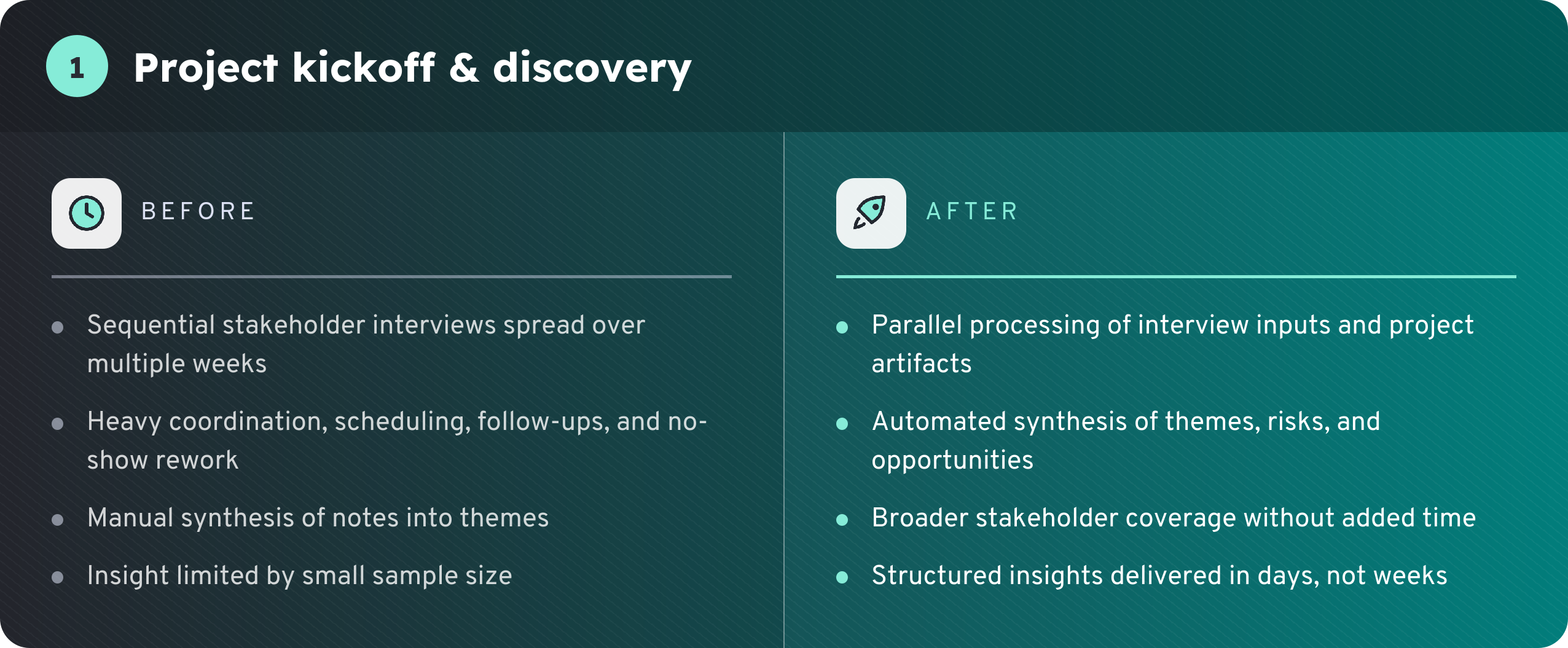
AI is used to process large volumes of qualitative and operational data faster and more consistently than manual methods allow. That includes stakeholder interviews, research inputs, call center data, and project artifacts. Rather than spending weeks synthesizing inputs, AI identifies patterns, surfaces friction points, and organizes findings into clear themes that inform strategy.
What changes in practice:
- Faster synthesis of qualitative data: Interview insights, research notes, and operational inputs are analyzed in hours instead of weeks.
- Reduced burden on teams: Less time spent recruiting, scheduling, and rescheduling interviews, which improves EX by minimizing off-hours coordination and no-show rework.
- More complete insight coverage: Exploratory qualitative research can be conducted at scale, capturing broader perspectives without extending timelines.
Enhancing and Scaling Deliverables
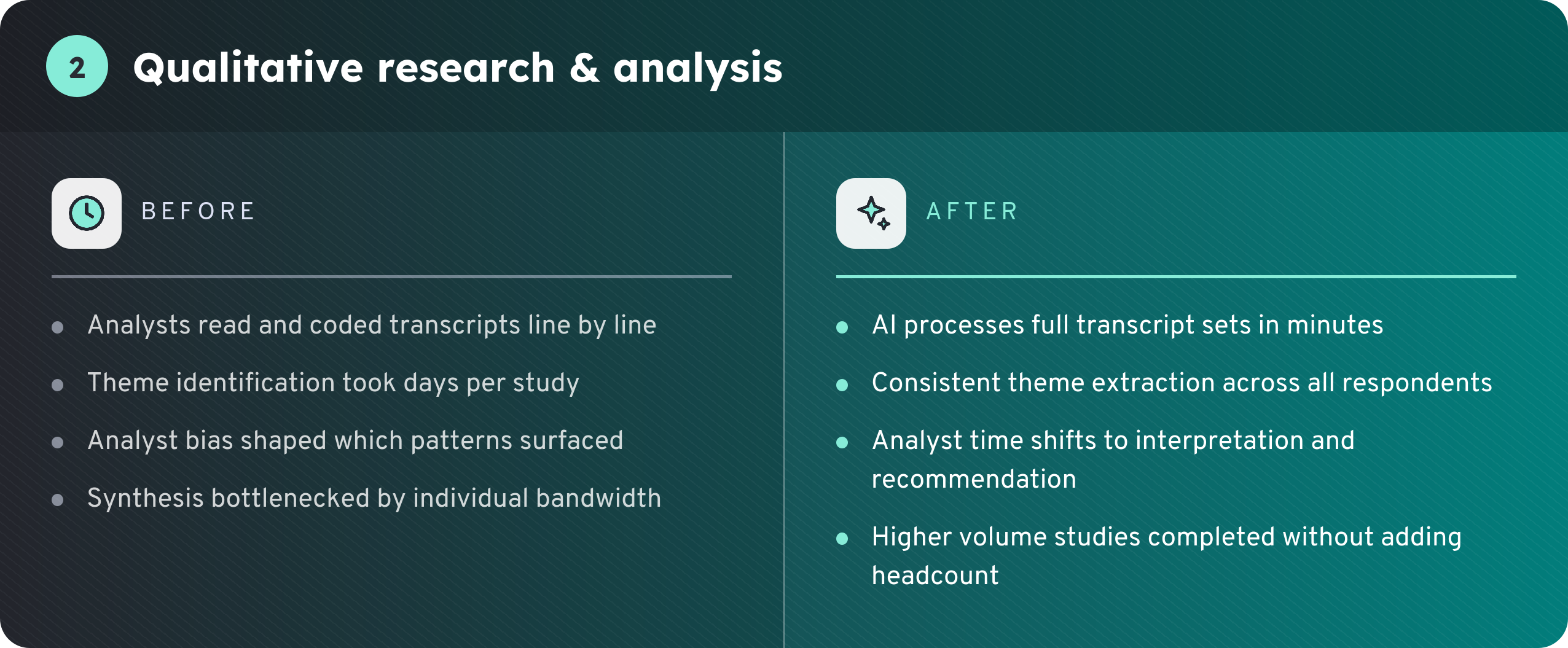
AI is embedded in how deliverables are created, updated, and scaled. This does two things: It removes repetitive work, and it improves consistency across outputs.
With AI, teams can focus on interpretation and strategy, rather than manual formatting, data manipulation, or version control.
What changes in practice:
- Elimination of repetitive production work: Standard deliverables can be updated, reformatted, or rebuilt without starting from scratch.
- Faster turnaround on client-facing materials: Presentations, reports, and analyses can be refreshed quickly as new data comes in.
- Consistency across outputs: Messaging, structure, and data presentation stay aligned across multiple versions and stakeholder audiences.
Applying Cross-Industry Expertise Effectively
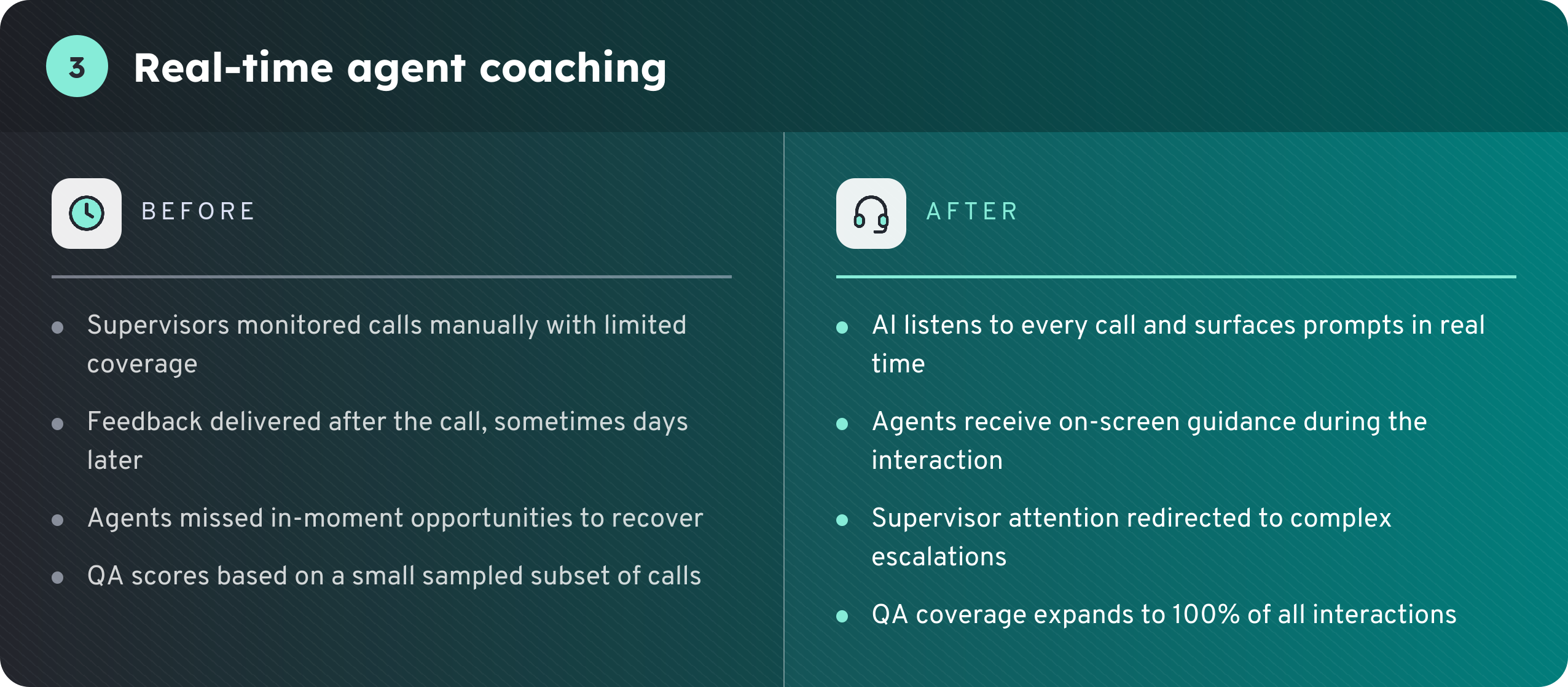
Every client engagement benefits from what Andrew Reise has learned across industries. AI makes it easier to bring that knowledge to bear without requiring clients to start from scratch. Organizations in healthcare, financial services, utilities, insurance, and retail face different customer populations, but many of the same underlying friction patterns.
What changes in practice:
-
Faster pattern recognition: AI surfaces relevant parallels across industries, helping teams apply proven frameworks without lengthy discovery cycles.
-
More targeted recommendations: Clients receive recommendations grounded in what has actually driven outcomes in comparable environments.
-
Reduced risk in decision-making: Clients benefit from a broader base of evidence without bearing the cost of extended research or experimentation.
Real-Time Intelligence in Contact Center Operations
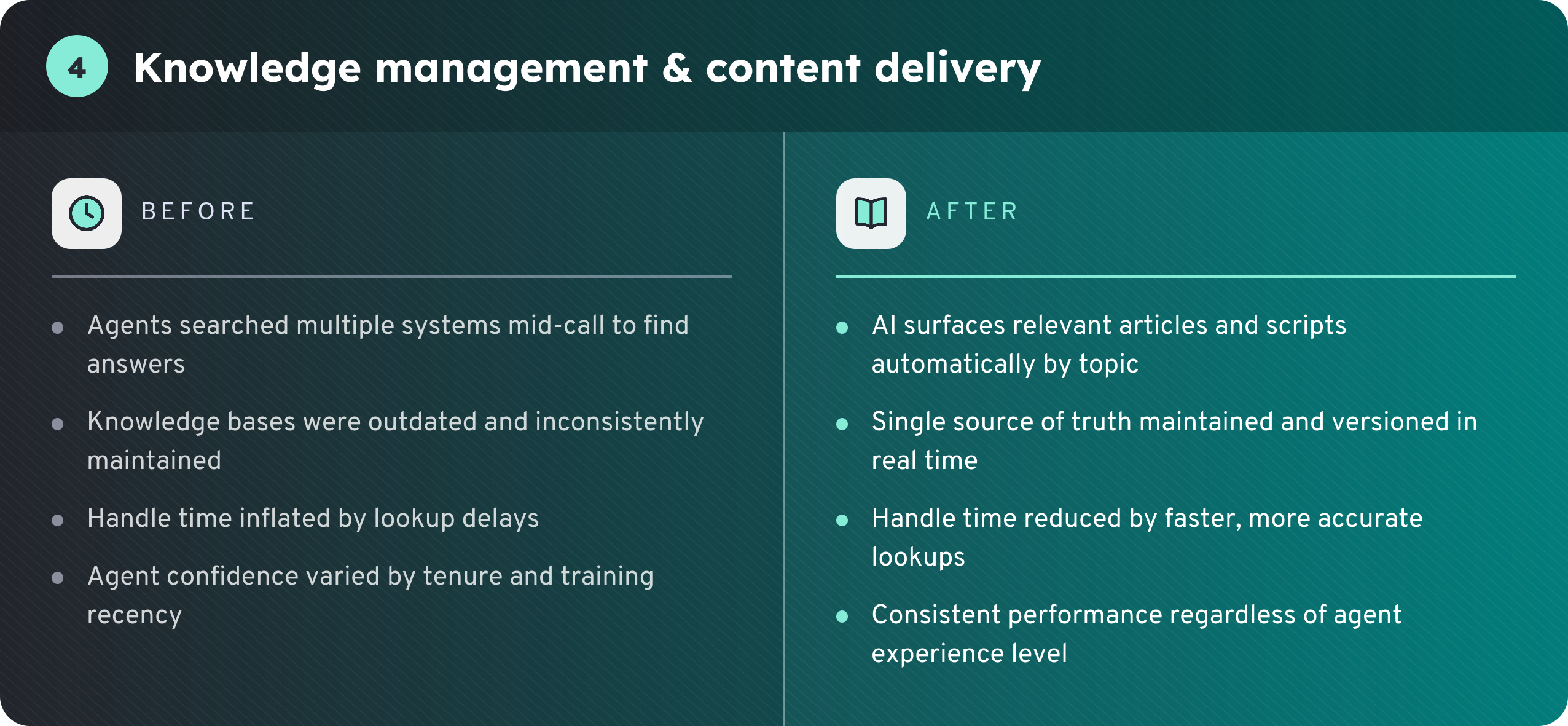
The contact center is one of the highest-leverage environments for AI, and one of the places where Andrew Reise has seen the most tangible, measurable impact for clients. AI enables real-time guidance, in-the-moment coaching, and continuous analysis of interactions at a scale that manual approaches cannot match.
What changes in practice:
- Real-time agent coaching: AI monitors interactions as they happen and surfaces relevant guidance (compliance reminders, de-escalation prompts, knowledge articles) exactly when agents need it.
- Continuous sentiment analysis: AI detects shifts in customer or agent sentiment during live interactions, enabling intervention before situations escalate.
- Speech and text analytics at scale: Thousands of interactions analyzed consistently, surfacing themes and friction points that would otherwise go undetected until they appear in survey data weeks later.
- Faster identification of operational gaps: Patterns across calls, chats, and digital interactions reveal where process, policy, or training issues are driving repeat contacts and escalations.
- Automated after-call work: AI-generated interaction summaries eliminate the manual effort of post-call wrap-up, freeing agents to move to the next customer faster and ensuring notes are consistent and complete. Utilita Energy deployed the Verint Wrap Up Bot to automatically summarize calls and post them to their system of record, reducing after-call work, lowering average handle time, and increasing agent capacity without adding headcount.
Why This Matters
Static deliverables inform decisions. Interactive deliverables support ongoing decision-making. The power of having enterprise data at your fingertips, continuously updated and actionable, means strategy doesn't expire after initial delivery.
What This Means for Your Business
AI only matters if it changes outcomes. Andrew Reise applies AI to increase the speed, quality, and impact of CX, EX, DX, and contact center strategy without requiring additional spend or complexity.
Here's what that looks like in practice:
- Faster project delivery: Insights that once took weeks are delivered in days, so teams can move from analysis to action sooner.
- Increased output without increased cost: Gain more stakeholder input, more analysis, and more refined deliverables without expanding team size or budget.
- More actionable insights, not just more data: AI surfaces patterns across customer journeys (similar to the work done in our Customer Experience strategy engagements) and translates them into clear, prioritized next steps.
- Reduced operational burden on your teams (EX impact): Spend less time on manual tasks, scheduling, and rework aligning with the same principles used in our Employee Experience strategy work.
- Improved CX where it matters most: Friction points in key interactions—billing, onboarding, support—are identified and addressed faster, leading to measurable service improvements.
- Better, faster decisions at the leadership level: Structured insights replace fragmented data, giving executives confidence in where to invest and what to prioritize.
- Greater return on existing investments: AI enhances the value of current systems and data, rather than requiring large-scale replacement or new technology spend.



Chapter 4
AI-Powered Solutions Built for Security, Trust, and Enterprise Standards
AI adoption raises valid concerns, particularly around data security, governance, and compliance.
Andrew Reise applies AI within secure, controlled frameworks designed to protect sensitive data while enabling speed and insight. Governance is built into the approach from the start, not added as an afterthought.
How Andrew Reise Handles Security and Governance
- AI applied within secure environments: All AI-enabled workflows are designed to operate within approved, enterprise-grade tools and configurations aligned to client requirements and risk profiles.
- Strict data handling and protection standards: Sensitive client data is not exposed, reused, or repurposed outside defined project boundaries. Access is controlled, and data usage is limited to what's necessary to deliver outcomes.
- Clear governance over AI usage: Defined processes ensure transparency in how AI is used, where it's applied, and what data is involved. This includes alignment with internal policies, regulatory requirements, and industry expectations.
- No "black box" decision-making: AI supports analysis and synthesis, but final recommendations are always validated through human expertise and strategic review.
We Are Enterprise-Ready by Design
Andrew Reise aligns with enterprise security expectations, including:
- SOC 2 Type II certification
- Secure handling of customer, employee, and operational data
- Controlled use of AI tools (e.g., enterprise configurations of platforms like ChatGPT or Claude)
- Compliance-aware design for regulated industries such as government and utilities
Why This Matters
AI introduces new capabilities and new responsibilities. Without clear governance:
- Data can be exposed or misused.
- Compliance risks increase.
- Trust erodes both internally and externally.



Chapter 5
AI + Human Expertise, Not One or the Other
AI is a powerful tool, but it doesn't replace experience, judgment, or accountability.
At Andrew Reise, AI enhances how work gets done. It doesn't automate away the thinking behind it. Every insight, recommendation, and roadmap is grounded in human expertise supported by AI, not driven by it.
What This Looks Like in Practice
- AI accelerates the work but humans define the direction. AI processes data, surfaces patterns, and organizes inputs. Consultants interpret what matters and decide what to do next.
- Better inputs lead to better decisions. With more complete data and faster synthesis, teams make clearer, more confident recommendations.
- More time is spent on high-value thinking. Less time spent on manual analysis and formatting means more focus on strategy, problem-solving, and client outcomes.
- Accountability stays with people, not tools. Every recommendation is reviewed, validated, and owned by experienced practitioners.



Chapter 6
Where We're Going Next
AI capabilities are evolving quickly, and so are the ways Andrew Reise applies them.
Here’s what we’re working on:
- Expanding AI-enabled solutions within core services: We're continuing to embed AI deeper into CX, EX, DX, and contact center strategy. That includes expanding our work in sentiment-based coaching, where AI monitors live interactions and surfaces real-time guidance when customer frustration is detected, and compliance coaching, where triggers fire automatically when an agent's behavior drifts from regulatory or policy requirements.
- Automating high-effort contact center workflows: We're actively developing and deploying agent-assist automation for tasks that consume disproportionate time without adding customer value. Post-call wrap-up is a prime example.
- Moving toward scalable, repeatable capabilities: We’re identifying opportunities to standardize high-value workflows and potentially package them into structured, reusable solutions.
- Advancing interactive deliverables: Building on the early exploration of dynamic AI-driven tools allows clients to engage directly with insights, roadmaps, and decision frameworks.
- Continuous team enablement and adoption: Ongoing investments in tools (e.g., Claude and ChatGPT) and internal training ensure teams are applying AI effectively, securely, and consistently.
What’s not changing:
We will continue to offer the same world-class deliverables and NPS score of 84. AI won't change our commitment to our customers or our core values.



Chapter 7
Let's Talk About What AI Can Do for You
AI creates value when it's applied to the right problems, in the right way.
If you're under pressure to define your AI strategy or want to get more from the work you're already doing, Andrew Reise can help you move forward with clarity and confidence.