Program governance is the structure, rhythm, and discipline that keeps strategy, execution, and accountability aligned across a large program. It defines who makes decisions, who manages risk, who tracks progress, and how information moves between them, so the right people make the right decisions at the right time with the right information.
Enterprise transformation programs are high-stakes initiatives. They span business units, integrate technologies, and depend on executive support to stay on track. When they drift, the symptoms are familiar: unclear decision-making, reactive problem-solving, and a program that is busy without being on schedule. Weak governance is usually the root cause.
This article covers the three-layer governance structure Andrew Reise uses on large programs, the meeting routines that keep it moving, the decision-rights model that removes ambiguity, the change control process that keeps scope honest, the tools that make governance visible, and a governance charter template you can put in writing before the first steering committee meeting.
The Program Governance Framework: Three Layers
Before you build routines, define the governance structure. This organizational blueprint outlines who makes decisions, who manages risks, and who tracks progress. We recommend three layers.
1. The Executive Steering Committee (ESC)
- Composed of senior leaders across business units, finance, IT, and key vendors
- Provides strategic oversight, makes funding decisions, and resolves escalations
- Meets monthly or biweekly, depending on program complexity
2. The Project Management Office (PMO)
- Day-to-day owner of delivery, reporting, and coordination
- Facilitates communication across workstreams and tracks benefit realization
- Owns the decision log, the scorecards, and the milestone plan
3. Cross-Functional Workstreams
- Business and technical teams responsible for executing specific initiatives
- Governed by workstream leads and supported by project managers
- Report progress, risks, and dependencies to the PMO
In a retail customer experience transformation, Andrew Reise used this three-layer structure to align more than 20 workstreams, including point of sale, loyalty, analytics, and training, under one unified program charter. The result was clarity about ownership and far less duplicated effort across teams.
Foundational Governance Structures
Before you build routines, define your program’s governance structure. This organizational blueprint outlines who makes decisions, who manages risks, and who tracks progress.
We recommend establishing three primary layers:
1. The Executive Steering Committee (ESC)
- Composed of senior leaders across business units, finance, IT, and vendors
- Provides strategic oversight, makes funding decisions, and escalates issues
- Meets monthly or biweekly, depending on program complexity
2. The Project Management Office (PMO)
- Day-to-day owner of delivery, reporting, and coordination
- Facilitates communication across workstreams and tracks benefit realization
- Owns tools such as decision logs, scorecards, and milestone plans
3. Cross-Functional Workstreams
- Business and technical teams responsible for executing specific initiatives
- Governed by workstream leads and supported by project managers
- Reports progress, risks, and dependencies to the PMO
In a recent retail customer experience (CX) transformation, we used this three-tiered structure to align more than 20 workstreams—including point of sale (POS), loyalty, analytics, and training—under one unified program charter, creating clarity and minimizing duplication across efforts.
Governance Routines That Drive Momentum
Governance is not static. It is a living process that depends on routine interaction. These touchpoints keep stakeholders aligned, surface emerging risks early, and enforce accountability without adding bureaucracy. Here is a sample cadence we have used in large-scale programs:
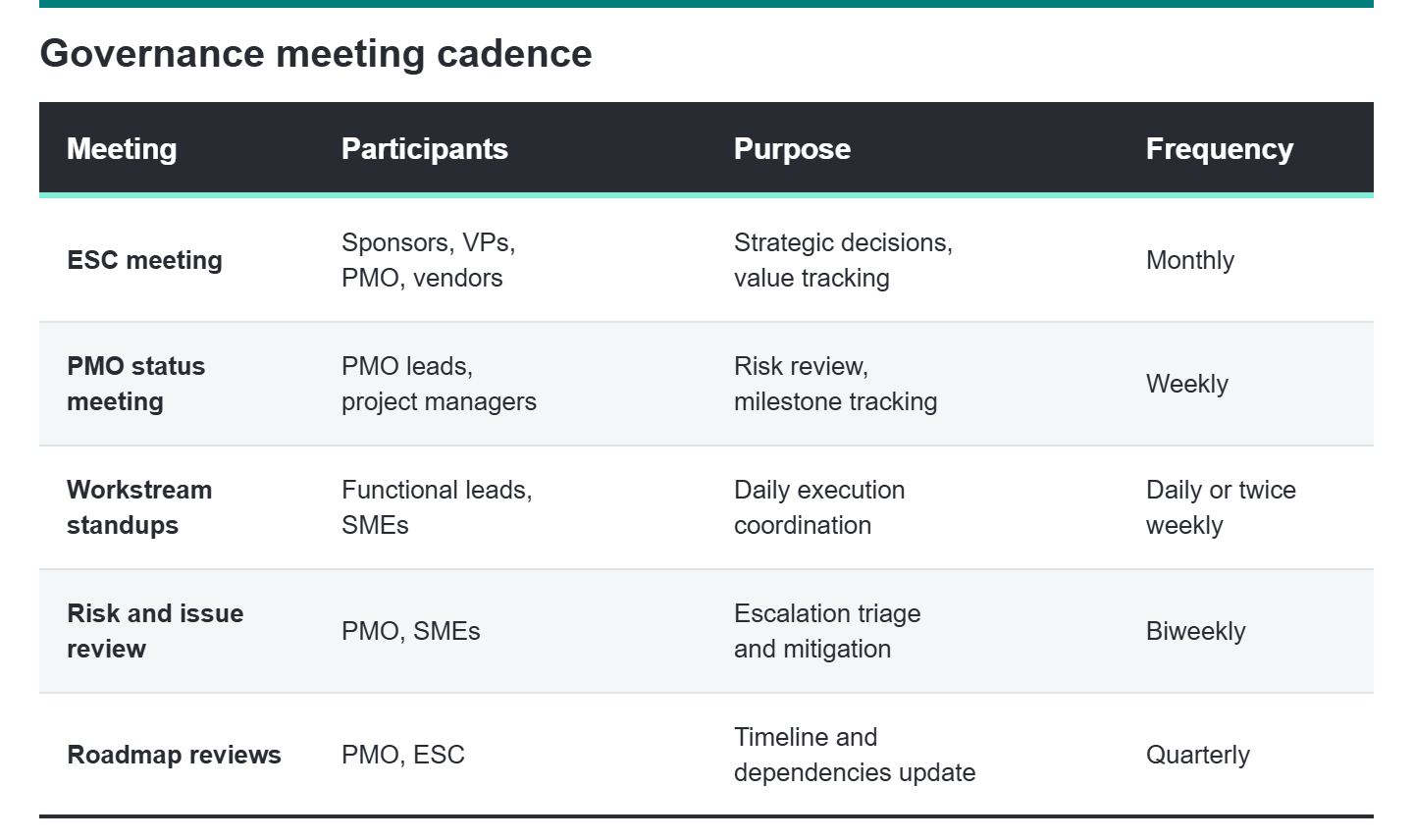
These meetings are not process for the sake of process. They are designed to surface the right issues to the right people. Even well-structured programs lose visibility and momentum without this consistency.
Decision-Making Models to Know Who Owns What
The clarity of decision-making is one of the most overlooked aspects of governance. Programs stall when no one knows who can approve scope changes, resolve conflicts, or shift funding.
We help clients implement a responsible, accountable, consulted, and informed (RACI) model to define decision rights across key categories:
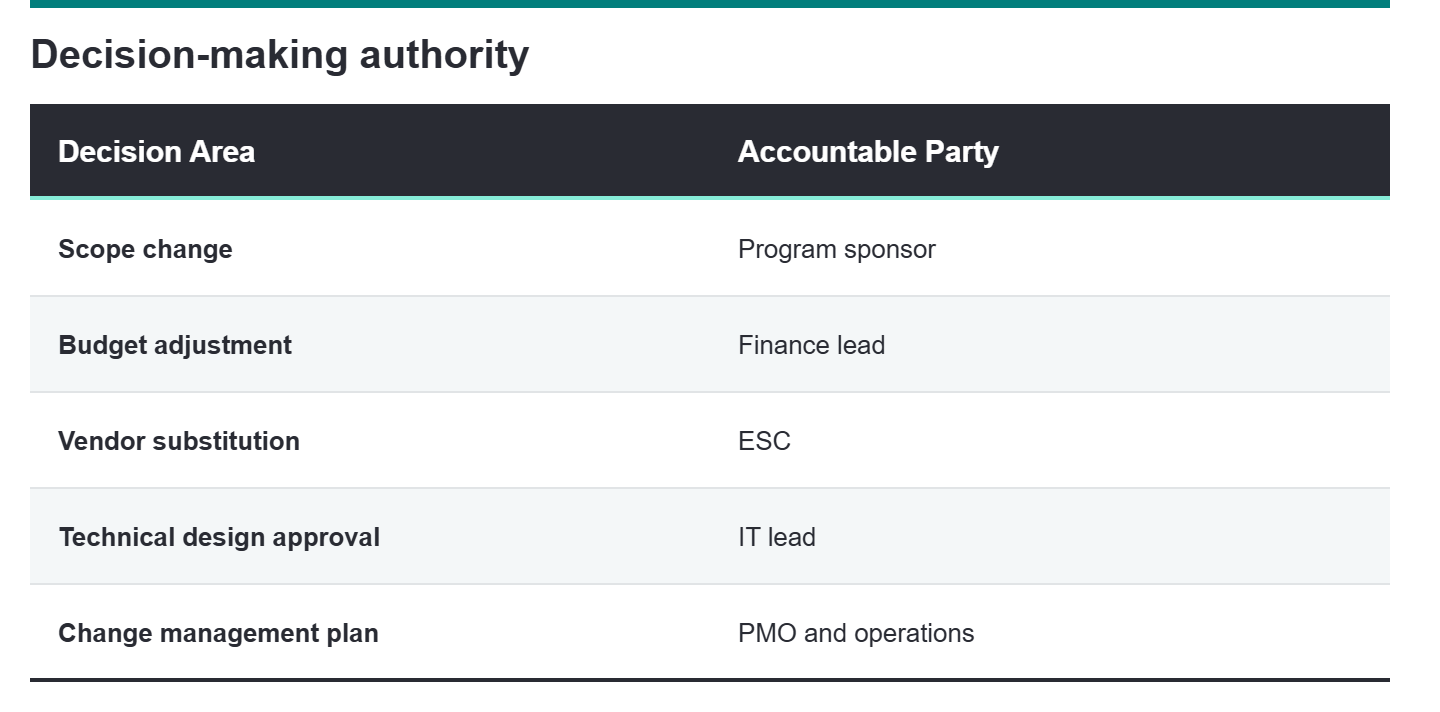
This approach eliminates ambiguity. Everyone knows who holds the pen.
With one past insurance client, we helped resolve months-long scope paralysis by formalizing decision authority in a governance charter. This resulted in faster approvals, clearer accountability, and less rework.
Change Control Processes That Actually Work
Programs evolve—it’s inevitable. But without a structured change control process, even small adjustments can create downstream chaos.
We help clients implement a lightweight but disciplined model that includes:
- Change Request Form
- Submitted by any workstream lead or stakeholder
- Includes business justification, impact analysis, and proposed timeline
- Impact Review
- PMO reviews against budget, timeline, and interdependencies
- Change categorized by severity (e.g., low, medium, high)
- Approval Path
- Low-impact: PMO discretion
- Medium-impact: Sponsor review
- High-impact: ESC approval
- Stakeholder Communication
- Approved changes are communicated via decision logs and roadmap updates
A past financial services client used this model to triage more than 80 change requests during a 12-month program. It prevented scope creep while maintaining agility.
Documentation and Transparency Tools
Governance works only when people can see what’s happening. We provide clients with tools that make governance visible and actionable:
- Decision logs: Document what was decided, by whom, and why
- Risk registers: Track severity, ownership, and mitigation plans
- Milestone trackers: Map progress against committed dates
- Scorecards: Visualize performance across budget, timeline, scope, and CX metrics
- Executive dashboards: Translate delivery status into business impact for senior leaders
During one enterprise-wide CRM implementation, we developed a dashboard that displayed not only project status but also end-user adoption, training completion, and Net Promoter Score (NPS) shifts by business unit. It kept leadership focused on outcomes, not just activities.
How Does Strong Governance Keep Large Programs on Track?
Governance frameworks provide the necessary decision-making structure, reporting cadence, and escalation channels needed to manage complexity and risk.
A past logistics client needed to modernize its digital platform while integrating with dozens of upstream and downstream systems. The initial program effort struggled with misaligned workstreams, reactive firefighting, and unclear executive engagement.
We designed and implemented a governance framework that included:
- An ESC charter with defined decision rights
- A weekly PMO cadence tied to milestone-based scorecards
- A risk escalation playbook to prioritize and triage issues
- A change control council with documented review thresholds
Within three months, program health improved across all dimensions—fewer escalations, faster decisions, and more confidence in execution. By the time the platform launched, the governance model had become standard operating procedure across the enterprise.
Governance Drives Program Success
Strong program management governance provides the clarity, cadence, and confidence necessary for success.
Effective governance leads to:
- Faster decision-making and fewer escalations
- Proactive risk management and greater confidence in execution
- Executive alignment and accountability
- Real-time visibility into performance and value
If your program is struggling with indecision or a lack of clear direction, it’s time to rethink your approach.
We specialize in helping companies of all sizes implement program management frameworks that drive results and become a standard operating procedure across the organization. Partner with Andrew Reise to create a structure that enables execution at every level.
A Governance Charter Checklist
Before the first steering committee meeting, put these in writing: the decision rights map (who approves scope, budget, vendor, and technical-design changes), the meeting cadence by layer (executive steering monthly, PMO weekly, workstreams daily or twice weekly), the escalation path with named roles, the change-control thresholds that route a request to the PMO, the sponsor, or the steering committee, and the reporting stack from workstream dashboard to executive summary. Programs that write these down before kickoff spend their meetings deciding; programs that do not spend them debating who decides.
Governance defines the decisions; the office that carries them out is its own discipline. See our guide to building a high-impact PMO.

Speak to an Expert
Talk with our EVP of Customer Experience about how we can help you design and implement customer, employee, digital, or contact center experience strategies that drive results.
Book a 30-minute meeting→